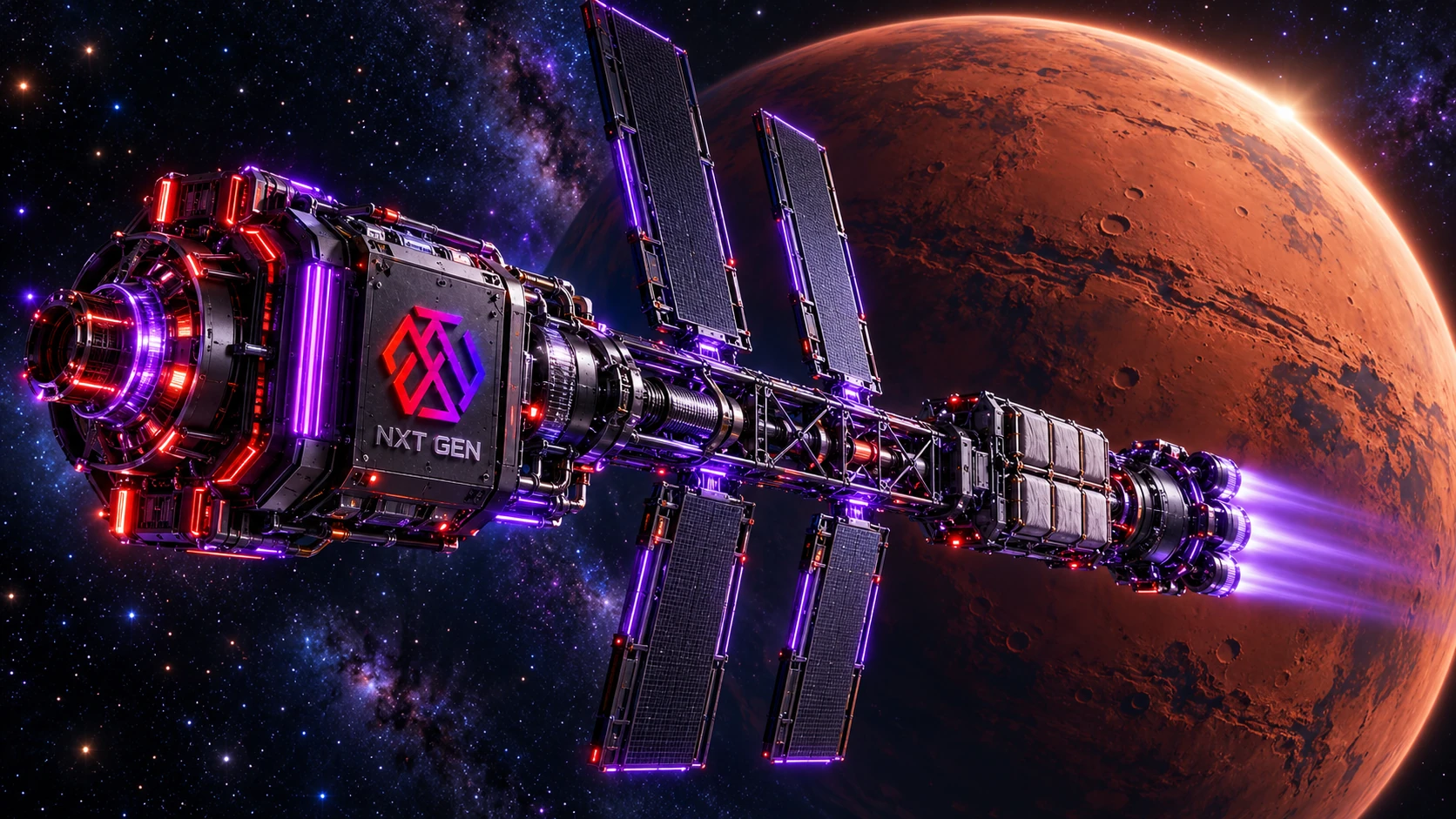
A planned demonstration beyond Earth orbit
NASA reported on October 20 that work is advancing on the nuclear power module for Space Reactor-1 Freedom. The future mission is intended to demonstrate fission power and nuclear electric propulsion beyond Earth orbit while carrying the SkyFall science payload toward Mars.
NASA is targeting a late-2028 launch. The spacecraft, its performance, and its schedule remain planned outcomes, so the update should be read as development progress rather than a completed flight demonstration.
The module turns heat into mission power
NASA describes a reactor at the end of a spacecraft boom that generates heat through fission. A closed-Brayton-cycle conversion system is intended to turn that thermal energy into electricity for spacecraft systems and electric propulsion. Radiators, controls, structural separation, power electronics, and thrusters must all support the same energy chain.
This architecture illustrates a systems-engineering truth: headline power output is only one part of usefulness. Conversion efficiency, heat rejection, mass, fault response, electromagnetic effects, and lifetime can determine how much power reaches the mission when it is needed.
Safety is designed into the operating sequence
NASA says the reactor will remain inactive until the spacecraft leaves Earth orbit. The agency also describes interagency reviews, continuous safety oversight, regulatory compliance, hazard analysis, and failure-tolerance work during development.
For any high-consequence system, assurance should follow the operating sequence. Teams should connect each hazard to a control, each control to verifiable evidence, and each mission phase to clear activation, monitoring, and safe-response criteria.
Integration evidence will decide the value
The SR-1 program is meant to build experience for future power and propulsion missions, including places where solar energy is limited. The transferable lesson is that a pathfinder earns value through what it proves about interfaces, suppliers, operations, qualification, and long-duration performance—not through novelty alone.
Advanced engineering organizations can apply that lesson now: maintain interface ownership across disciplines, test conversion and loads together, qualify failure responses, and preserve the data needed for the next design decision. A bold mission becomes repeatable infrastructure only after its evidence can support the next system.