A precise task creates a clear business case
ABB published a new customer deployment on September 28 involving Andover Corporation, a manufacturer of precision optical filters. Growing demand had made manual chamfering—a process that creates a controlled bevel around each filter—difficult to scale. The work also required repetitive wrist movement and consistent positioning around delicate optical surfaces.
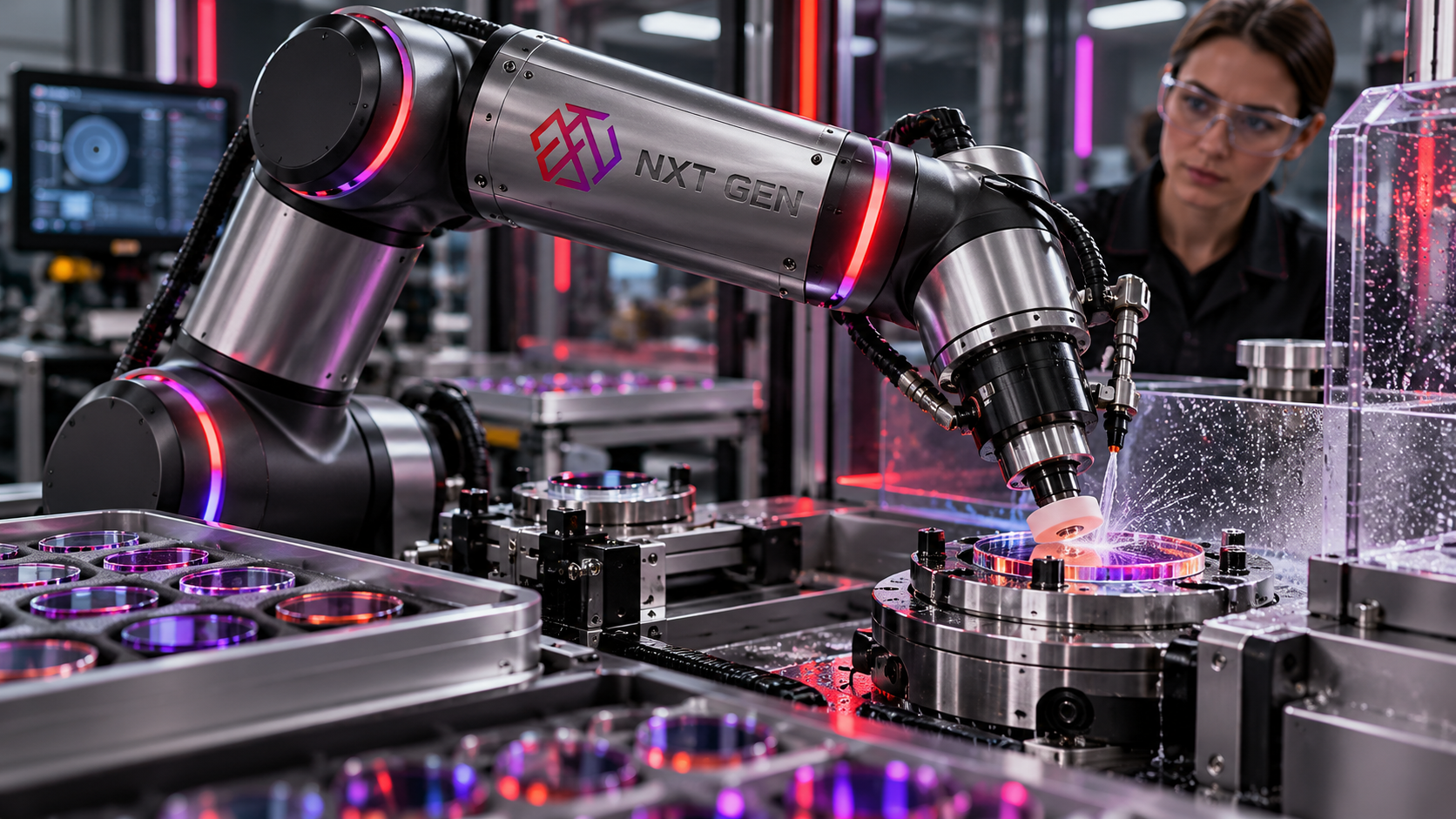
The deployed cell uses a collaborative robot to retrieve a filter, move it through a centering station, and position it against a rotating diamond chamfer tool. ABB reports that the system can process approximately 500 filters in less than four hours with minimal operator intervention. For every 1,000 filters, the company estimates that automation saves more than eight hours of manual work.
Precision depends on the whole cell
The robot is only one component. Grippers, interchangeable vacuum cups, centering hardware, embedded diamond tooling, coolant, fixtures, controls, and operator workflow all contribute to the result. The cell accommodates filters from 10 millimetres to two inches in diameter and handles parts weighing as little as 0.4 grams.
ABB states that its GoFa Ultra Accuracy capability provides path accuracy down to 0.03 millimetres and absolute-position accuracy of 0.1 millimetres. In this application, repeatable motion also supports more consistent chamfer geometry and reduces the chance that loose abrasive material will scratch an optical surface.
Those figures are vendor- and customer-reported, not an independent industry benchmark. They still illustrate an important principle: useful robotics projects are measured at the process level. Throughput, defects, changeover time, operator effort, and maintainability matter more than the robot’s specification sheet by itself.
Collaborative does not mean risk-free
The deployment was designed so technicians could work near the equipment without a large fenced enclosure. That flexibility comes from the cobot’s power- and force-limiting functions, integrated torque sensing, rounded geometry, and application design.
A “collaborative robot” label does not make every application automatically safe. The workpiece, gripper, tooling, fixtures, speed, reach, and surrounding equipment can introduce hazards. ABB’s own guidance calls for an application-level risk assessment using the applicable industrial-robot and collaborative-operation standards. Safety should be validated for the completed cell, not assumed from the arm alone.
Start with a constrained, measurable workflow
For organizations considering robotics, the strongest first candidate is often repetitive, ergonomically difficult, quality-sensitive, and stable enough to measure. Establish the current cycle time, defect rate, labour exposure, changeover effort, and expected production range before selecting hardware.
Then design the cell around the people who operate and maintain it. Include tooling, safety functions, recovery steps, spare parts, cybersecurity, data collection, and staff training in the implementation plan. A well-chosen cobot project does not replace judgment; it moves a repeatable burden away from people while making quality and capacity easier to control.