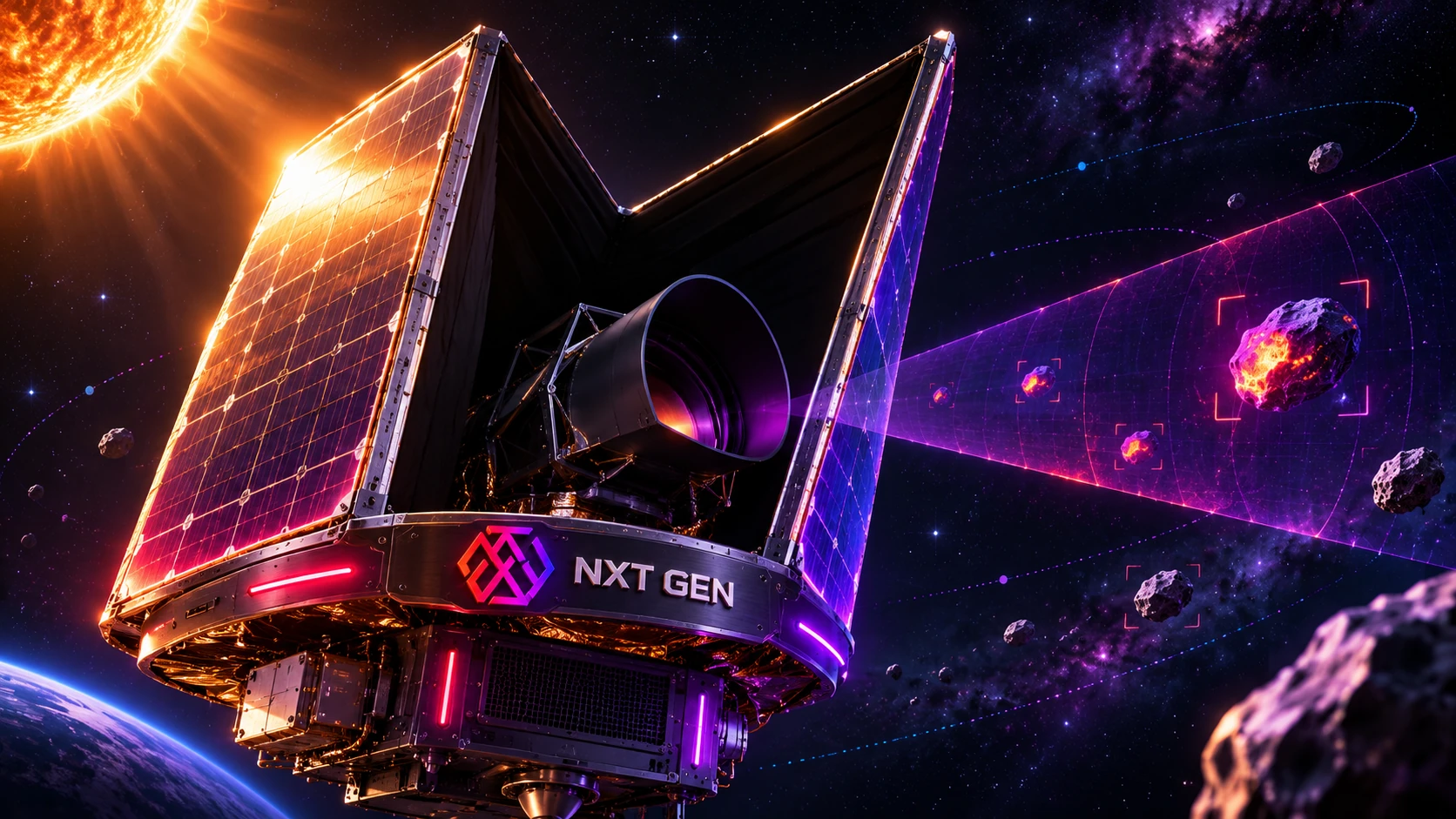
One structure carries several mission jobs
NASA reported on October 26 that solar arrays had been integrated onto NEO Surveyor’s largest component: a sunshade about 20 feet tall with an 8-foot-wide base. Its two flat panels meet at a 23.5-degree angle, carry 864 solar cells, and are designed to provide up to two kilowatts of power.
The structure also blocks direct solar glare and helps keep the infrared telescope cool. That makes it more than a shield or a power panel; it is part of the observatory’s optical, thermal, electrical, structural, and pointing system.
Infrared performance begins outside the detector
NEO Surveyor will use two 16-megapixel infrared detector arrays observing in two bands. Those measurements are intended to help estimate an object’s temperature and size, including dark near-Earth objects that can be difficult to characterize in visible light.
Detector capability depends on the environment around it. Stray light, temperature, alignment, vibration, contamination, and available power all affect whether the instrument can produce useful data. The sunshade therefore protects measurement quality while supporting the energy budget.
Integration turns separate tests into system evidence
NASA says the sunshade completed thermal-vacuum testing in March and was delivered in May. Sensors and the solar arrays were then integrated, followed by functional and performance tests. Each step adds evidence, but later integration can also introduce new interfaces and failure paths.
A good acceptance program preserves traceability from the requirement to the component test, integration test, and mission-level verification. It also retests the functions most likely to change when hardware, harnesses, coatings, sensors, or software are added.
The transferable lesson is managed coupling
Multifunction structures can reduce mass, volume, and part count, which is valuable in aerospace. The tradeoff is coupling: one deformation, thermal condition, contamination event, or electrical issue can influence several mission functions at once.
Advanced engineering teams should give shared hardware clear interface ownership, model cross-domain effects early, define integrated acceptance criteria, and test off-nominal conditions. The design earns its efficiency only when the combined evidence is as strong as the individual functions.