A landing system tested closer to Earth
NASA reported on September 24 that its Safe and Precise Landing – Integrated Capabilities Evolution, or SPLICE, experiment had successfully completed simulated lunar descent and landing manoeuvres during recent testing near Armstrong Flight Research Center in California. An Alta-X drone carried the guidance and navigation experiment during the August 27 flight.
Using a drone allows engineers to exercise sensors, processors, and algorithms repeatedly without a full space mission. The objective is broader than a single vehicle: develop a reusable descent-and-landing capability for the Moon, Mars, icy worlds, and other difficult destinations.
Several technologies act as one system
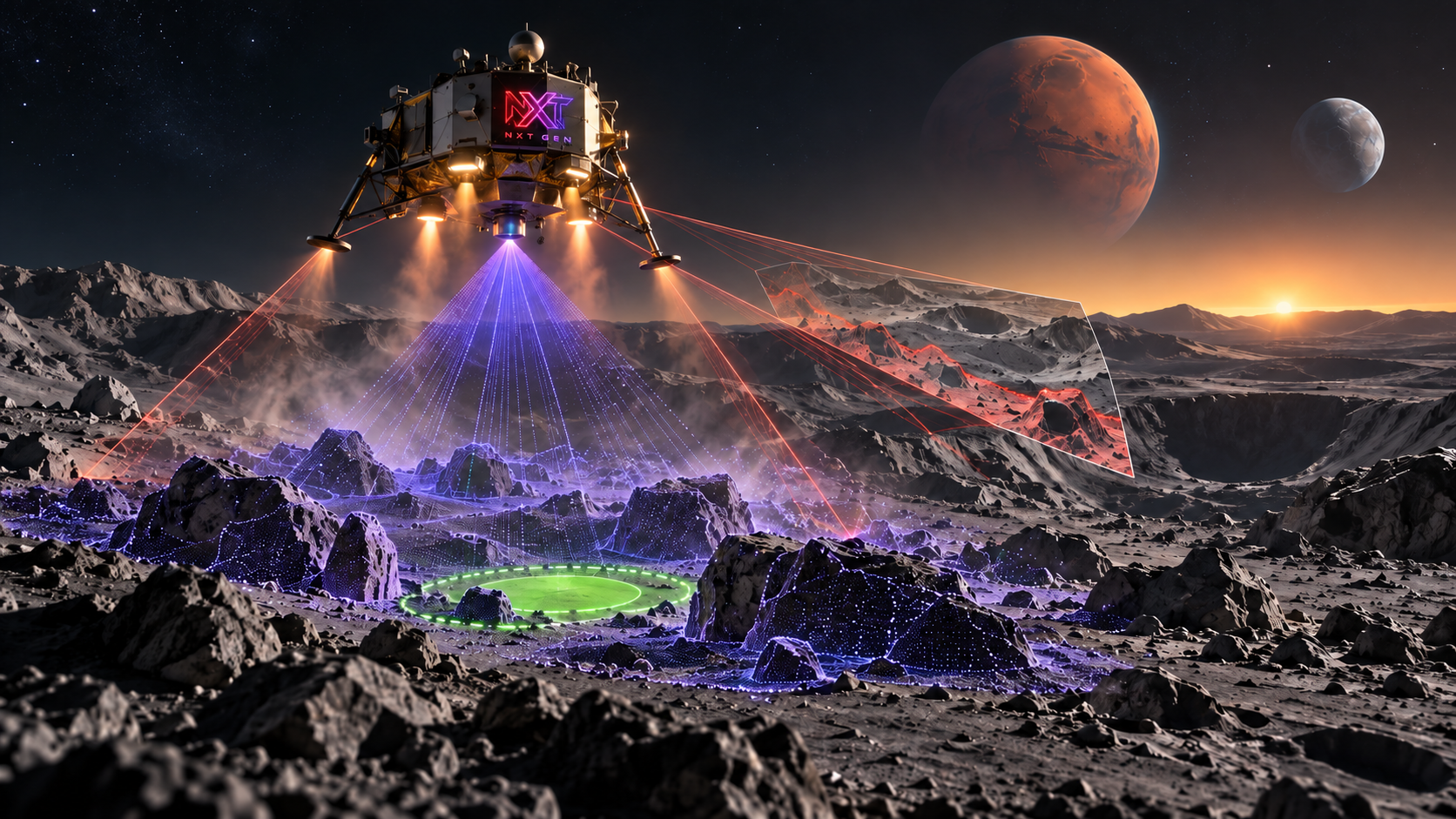
SPLICE combines terrain-relative navigation, navigation Doppler lidar, hazard-detection lidar, onboard computing, hazard-detection software, and adaptive guidance. Cameras compare live imagery with stored orbital maps to estimate location. Lidar measures velocity and altitude and builds a 3D view of the surface. The onboard computer then identifies hazards and can guide the vehicle toward a safer site.
This sensor-fusion approach is important because future missions may need to land near shadowed craters, rough terrain, or other scientifically valuable regions that offer less margin for error than broad, flat landing zones.
Autonomy becomes essential when latency matters
A spacecraft descending toward the surface cannot wait for detailed instructions from Earth at every step. Communications delay, limited bandwidth, and a rapidly changing flight state require the vehicle to interpret data and act locally.
That makes precision landing a strong example of edge autonomy: sensing, mapping, decision-making, and control happen on the vehicle under strict power, mass, and reliability constraints. The same engineering pattern appears in advanced aviation, remote inspection, mining, and other environments where connectivity cannot be assumed.
The organizational lesson is integration
The visible breakthrough is not one sensor or algorithm. It is the integration of multiple technologies into a system that can be tested, observed, and improved as a whole. Aerospace programs—and complex technology programs more broadly—benefit from clear interfaces, representative testing, disciplined data capture, and staged increases in autonomy.
For organizations building safety-critical systems, the SPLICE test is a useful reminder: autonomy earns trust through repeatable evidence. The path to more ambitious destinations runs through rigorous integration on the ground.