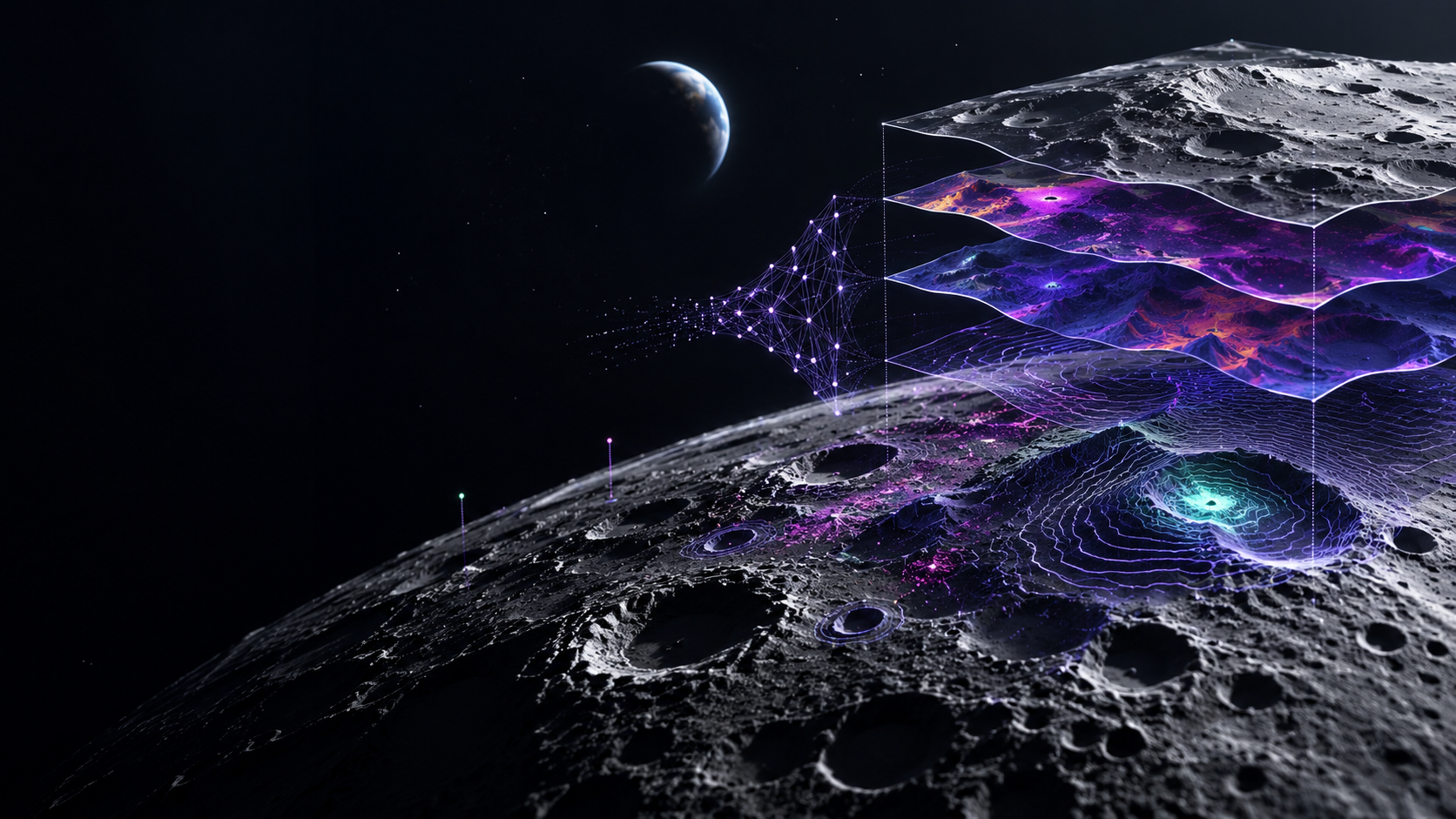
A foundation model built for the Moon
On September 10, NASA and IBM released the NASA–IBM Lunar Foundation Model, one of the first open-source foundation models built specifically for lunar science. NASA says it was trained primarily on Lunar Reconnaissance Orbiter data and is publicly available with model resources, datasets, and code for experimentation. The goal is to help researchers analyze a scientific record too large and varied to handle efficiently through one task-specific model at a time.
Unlike a general-purpose chatbot, this is a domain model. It learns a reusable representation of the Moon’s surface, then can be adapted to narrower tasks with smaller amounts of labelled data. That distinction matters: the model is designed around the structure, sensors, resolution, and lighting conditions of one scientific environment.
Many instruments, one usable representation
The release brings together roughly two million co-registered image tiles across multiple lunar datasets. The public model card describes 11 modalities and two very different spatial scales: high-resolution Lunar Reconnaissance Orbiter camera imagery at about one metre per pixel and broader multispectral observations at about 100 metres per pixel. It also encodes acquisition geometry because shadows and illumination can change how the same terrain appears.
This is the central technical lesson. Valuable data often arrives in incompatible formats, resolutions, and time periods. The model’s usefulness comes from harmonizing those inputs before asking it to solve a specific problem. For organizations on Earth, the analogy is familiar: customer records, operational logs, documents, images, and sensor feeds only become a durable AI asset when definitions, context, quality, and lineage are aligned.
From craters to ice prospectivity
NASA highlights three early applications: detecting and measuring craters, mapping unusual volcanic features, and estimating where water ice may be stable near the lunar poles. IBM reports that, on one ice-prospectivity evaluation, the model reduced error by 22% versus a task-specific SwinV2 transformer; it also matched or improved on strong baselines in crater and volcanic-feature work.
Those results are promising, but the release should be read as a research platform rather than an autonomous mission system. The model and its task-specific checkpoints document limitations, and the public repository is explicitly oriented toward fine-tuning, benchmarking, and experimentation. Human review, domain expertise, and independent validation remain essential—especially when model outputs may influence expensive or safety-sensitive decisions.
What organizations can take from it
The lunar model points to a more practical way of thinking about enterprise AI:
- Start with a bounded domain and a real decision, not a broad promise to “add AI.”
- Invest in data alignment and metadata before measuring model performance.
- Build a reusable base that can support several workflows instead of isolated pilots.
- Keep evaluation task-specific; performance on one use case does not prove readiness for another.
- Separate exploration from operations, with clear review gates before outputs affect people, money, safety, or customers.
Open models also make the work inspectable. Teams can examine the code, model card, datasets, and benchmark results rather than relying only on a vendor claim. That transparency does not remove governance—it makes stronger governance possible.
The broader signal
The most interesting part of this release is not that AI can identify a crater. It is that decades of specialized observations can be converted into a shared, adaptable layer for future research. The same pattern is emerging across engineering, climate, healthcare, manufacturing, and infrastructure: domain-specific foundation models can help organizations reuse complex data across several carefully governed tasks.
For business leaders, the takeaway is straightforward. The competitive advantage will rarely come from using the largest model. It will come from connecting the right data, preserving its context, defining the decision that matters, and validating the result well enough to trust it.